The Nguyen dynasty ruled from Hue from 1802 until 1945, and thirteen emperors left behind a citadel, a walled palace, dozens of temples and seven substantial tomb complexes. UNESCO listed the whole ensemble in 1993. The sites are spread across roughly 20 km of countryside along the Perfume River, and trying to see them all in a day produces exhaustion rather than understanding.
This is a guide to choosing. Each entry says what the site is actually like, not what a brochure claims.
The Imperial Citadel
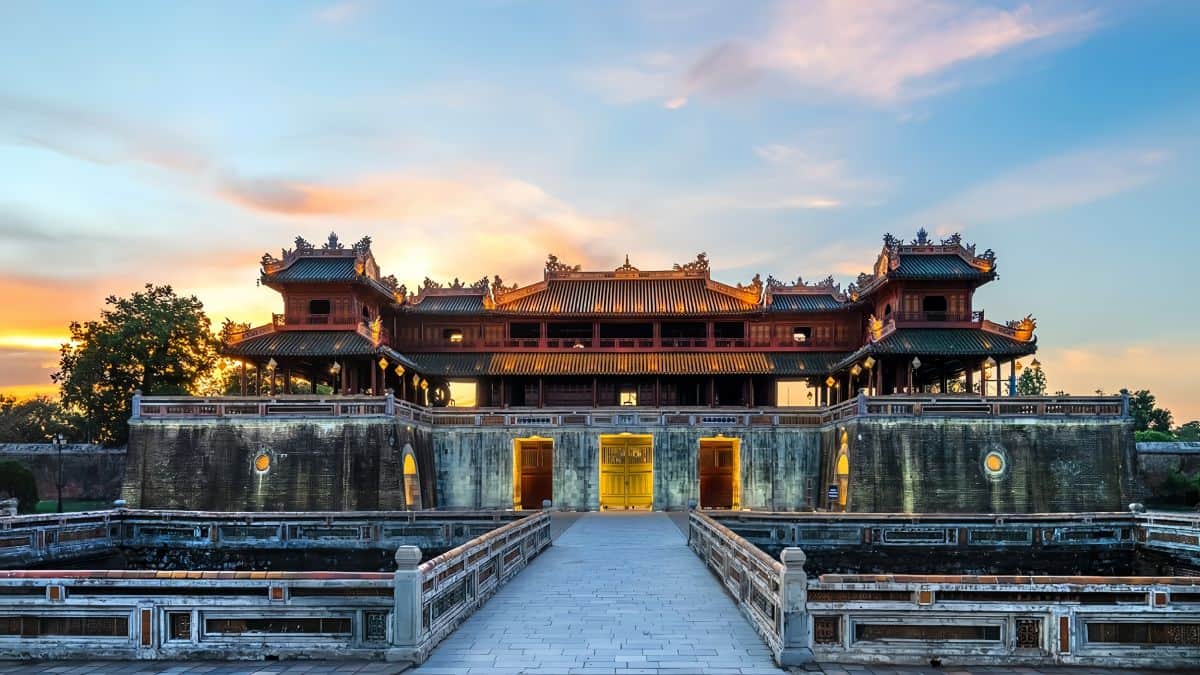
Start here, because everything else refers back to it. The Citadel is a fortified city almost 10 km around, built on Vauban principles by French-trained engineers, and inside it sits the Imperial City — the walled palace compound where the court lived and governed.
Be prepared for absence. The palace was hit hard in 1947 and again during the 1968 Tet Offensive; of around 160 original buildings, roughly 20 survive. What remains is remarkable — the Ngo Mon gate, the Thai Hoa palace with its 80 lacquered columns, the Mandarin halls, the Forbidden Purple City reduced mostly to foundations — but large stretches are open ground. Restoration has been ongoing for three decades and is visibly accelerating.
Allow two to three hours. Go early: there is little shade, and Hue is genuinely hot from April to August.
Thien Mu Pagoda
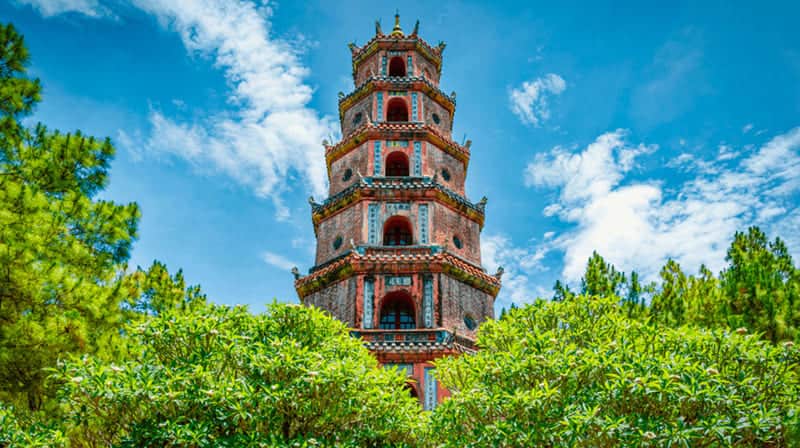
A seven-storey brick tower on a bluff above the river, founded in 1601 and the unofficial symbol of the city. It is small and takes twenty minutes, but the setting is the point, and it is an active monastery rather than a museum. The Austin sedan that carried the monk Thich Quang Duc to his self-immolation in Saigon in 1963 is kept here.
It sits between the Citadel and the tombs, which makes it a natural stop rather than a destination.
The royal tombs
These are not graves so much as retirement estates that became mausoleums — most emperors built them while alive and used them as retreats. Each reflects the ruler who commissioned it, and they differ enough that visiting three is not repetitive.
Minh Mang (1840–43) — 12 km from the centre
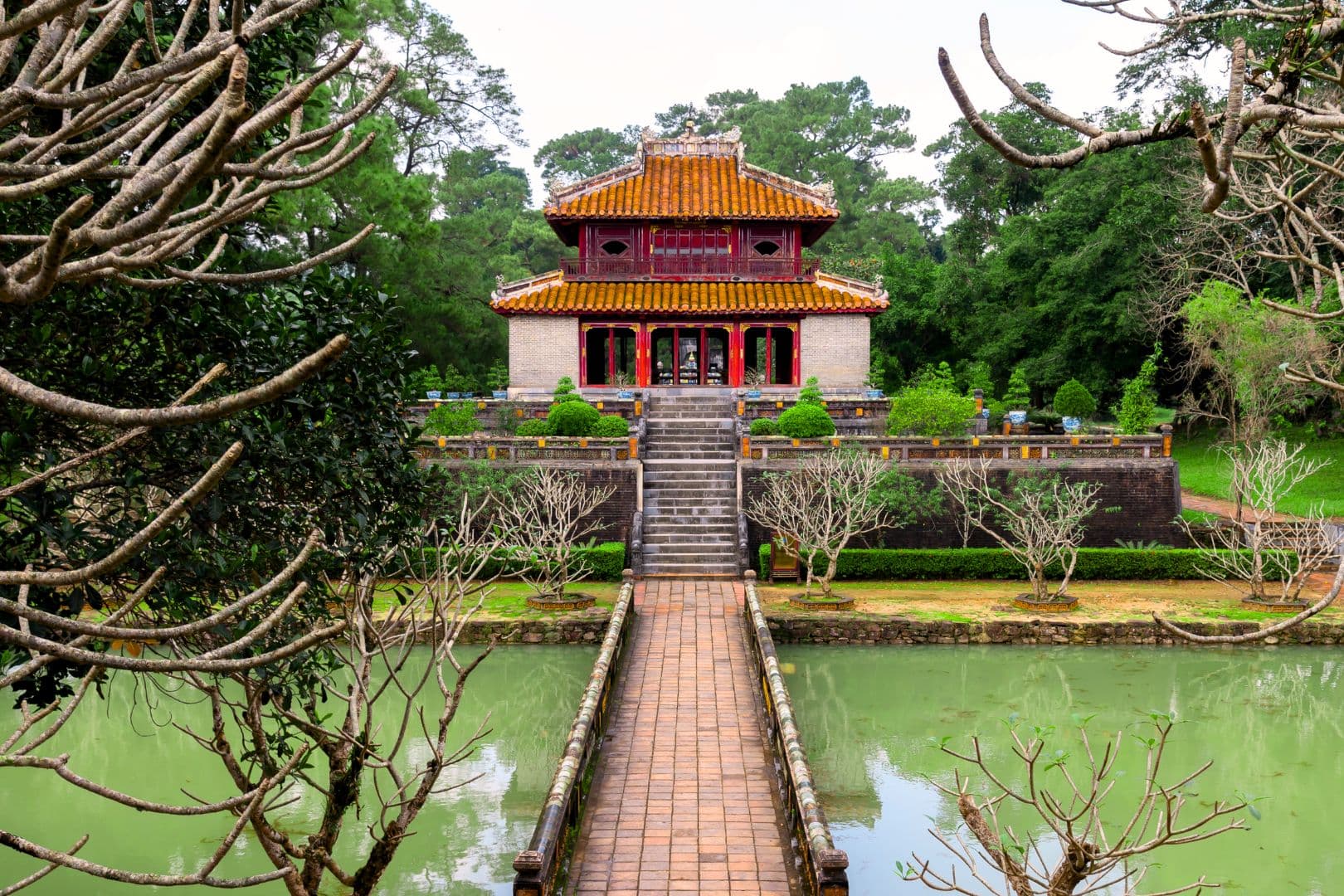
The most formally satisfying of the three. Forty structures arranged along a single axis across 18 hectares, alternating courtyards, lakes and pavilions in strict symmetry. Minh Mang was a Confucian traditionalist and the architecture argues his case. Go if you respond to landscape and proportion.
Tu Duc (1864–67) — 7 km from the centre
The opposite approach: deliberately asymmetric, built around a lake with a boating pavilion, designed as a working residence for an emperor who wrote poetry there for sixteen years before his death. It is the most atmospheric, and pine shade makes it the most comfortable in summer. Tu Duc is not buried in it — the real grave site was never disclosed, and the labourers who knew were executed.
Khai Dinh (1920–31) — 10 km from the centre
Far smaller and completely different in character: a blackened concrete structure climbing a hillside, fusing Vietnamese, Baroque and Gothic forms. Inside, every surface of the main chamber is covered in mosaic made from broken porcelain and glass, under a painted ceiling. Contemporaries thought it vulgar. It is the most photographed of the tombs and the most immediately striking.
The other four
Gia Long, Thieu Tri, Duc Duc and Dong Khanh are quieter, less restored, and free or nearly so. Gia Long in particular is a long trip on poor roads for a site with little signage. Worth it only if you have a third day and an interest that has already been established.
Beyond the imperial sites
An Dinh Palace — an early 20th-century residence in European style, with restored frescoes. Central and often empty.
Ho Quyen — a small stone arena built in 1830 for staged fights between elephants and tigers. Ruined, unattended, and unlike anything else in Vietnam.
Thanh Toan bridge — a tiled covered bridge from 1776 in a village 8 km east, usually combined with the surrounding rice fields.
The DMZ, Quang Tri — 70 km north, and a completely different subject: the Hien Luong bridge on the former border and the Vinh Moc tunnels, where a village of 300 lived underground for six years.
Practical notes
Tickets. Sites are ticketed individually — the Citadel is around 200,000 VND, each major tomb around 150,000 VND. Combination tickets covering the Citadel and two or three tombs cost less than buying separately and are sold at the entrances.
Distances. The tombs lie in different directions, 7–15 km out. Cycling is pleasant in winter and punishing in summer. Most visitors use a car or a boat for part of the route.
Time of day. The Citadel opens at 7am; arriving then buys you an hour of cool air and empty courtyards. Late afternoon light suits the tombs.
Dress. Thien Mu is a working monastery: covered shoulders and knees.
Season. October to December is the rainy season and can be genuinely wet. February to April is the most comfortable.
Building a realistic day
A sensible half-day is the Citadel, Thien Mu and one tomb. A full day adds a second and third tomb without rushing. Anything more is a checklist rather than a visit.
Because the sites sit in different directions from the city, the route matters as much as the list. A private car with a driver removes the two things that usually break a Hue itinerary — the midday heat between stops, and the difficulty of getting a taxi back from a tomb complex at closing time. Three-site, four-site and five-site day tours exist precisely because those are the combinations that fit comfortably into the daylight.